Toyota Hilux in the Australian Market vs. Isuzu D-MAX in the Thai Market: A Ten-Year Reliability Battle of Two âDurableâ Pickup Trucks
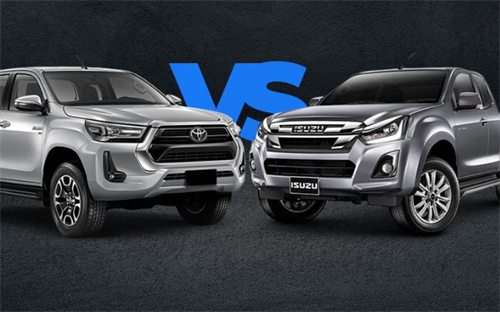
For decades, the Toyota Hilux and Isuzu D-MAX have been the backbone of the pickup truck segment, earning their reputations for durability, versatility, and reliability. In Australia, the Hilux is a fixture on farms, construction sites, and off-road trails, celebrated for its ability to handle harsh outback conditions, long-distance hauling, and rugged terrain.
Conversely, in Thailand, the D-MAX has established dominance as a commercial and fleet vehicle, navigating dense urban traffic, tropical climates, and frequent heavy-duty workloads. Despite originating as utilitarian workhorses, both vehicles have evolved to combine technological refinement with enduring mechanical toughness, making them compelling choices for buyers seeking a blend of lifestyle and business utility.
Market Context and Ownership Culture:
The Australian market has nurtured the Hilux into a vehicle capable of withstanding extreme environmental stressors, from desert heat to flooded river crossings. Its widespread adoption among farmers, tradies, and adventure enthusiasts reflects its ability to combine heavy-duty utility with dependable performance. Many owners accumulate upwards of 25,000 kilometers annually, often under harsh conditions, yet Hilux trucks maintain mechanical integrity, highlighting Toyotaâs reputation for long-term reliability.
In Thailand, the D-MAX thrives in a contrasting context, where its lighter kerb weight, efficient diesel engine, and robust chassis make it ideal for both urban deliveries and rural transport. The tropical climate, with high heat and frequent rainfall, places a different kind of stress on the vehicle compared to Australia, yet the D-MAX consistently demonstrates its capacity to endure heavy-duty usage over prolonged periods. The differing environmental and operational demands reveal that reliability is not solely a measure of mechanical strength but also of market-specific suitability.
Technical Architecture and Long-Term Stressors:
The Toyota Hilux in Australia features either a 2.4-litre or 2.8-litre turbo-diesel engine. The 2.8-litre variant produces 165 kW of power and 550 Nm of torque, offering strong performance for towing, hauling, and challenging terrain navigation. Its six-speed Aisin automatic transmission provides responsive power delivery, especially under heavy load, while off-road systems such as Multi-Terrain Select, hill-assist, and Active Traction Control optimize grip and stability. The ladder-frame chassis delivers a 310 mm ground clearance, allowing the Hilux to traverse rugged terrain with confidence.
In comparison, the Thai-market Isuzu D-MAX predominantly uses a 1.9-litre turbo-diesel engine, with a 3.0-litre turbo available for higher trims such as the Blade, producing 140 kW and 450 Nm. Its six-speed automatic prioritizes smoothness and torque management, while Rough Terrain Mode and a rear differential lock improve off-road traction. Despite a lower ground clearance of 230 mm, the D-MAX features a wading depth of 800 mm and an approach angle of 30.5 degrees, demonstrating its capability to handle wet and uneven conditions. In both cases, these trucks reflect engineering tailored to market-specific driving demands, with Hilux optimized for long-range heavy-duty performance and D-MAX calibrated for frequent payload and off-road versatility in tropical and urban environments.
Payload, Load Space, and Towing:
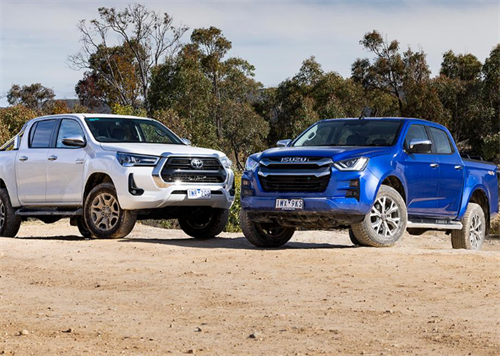
Both trucks continue to balance their commercial origins with modern lifestyle demands. The Hilux offers a slightly longer load bed across all body styles, with the Double Cab measuring 1555 mm and the Single Cab extending to 2350 mm, while the D-MAXâs Double Cab measures 1520 mm and the Single Cab 2290 mm. While Hilux prioritizes load length, the D-MAX excels in payload, accommodating up to 970 kg in Double Cab and 1205 kg in Single Cab configurations. Both trucks achieve a maximum braked towing capacity of 3500 kg, but real-world testing reveals the practical advantages of the D-MAX.
For instance, towing a full 3500 kg trailer leaves the Hilux with minimal legal payload, whereas the D-MAX retains sufficient capacity for a driver, gear, and tools. These distinctions demonstrate that the Hilux favors longer items and on-road towing stability, while the D-MAX provides superior payload management, especially under full-load scenarios common in fleet and tourer use.
Engine Performance, Fuel Economy, and Running Costs
The Hilux GR Sportâs 2.8-litre engine provides a robust 165 kW and 550 Nm, ideal for dynamic driving and heavy-duty towing, though it consumes approximately 10 litres per 100 km under real-world conditions. The D-MAX Bladeâs 3.0-litre turbo-diesel engine delivers 140 kW and 450 Nm, with slightly lower fuel consumption around 9 litres per 100 km. Both trucks utilize six-speed automatic transmissions, but the Hilux emphasizes a sharper throttle response, whereas the D-MAX favors smoothness and torque distribution. Long-term running costs further differentiate the two models. The Hilux requires service every 10,000 km or six months, resulting in 15 service visits over 150,000 km, totaling approximately AUD 4,350.
The D-MAX stretches intervals to 15,000 km or 12 months, requiring only 10 services over the same distance, which offers reduced downtime and practical advantages for high-mileage users. These factors indicate that while the Hilux offers greater peak engine output and towing confidence, the D-MAX prioritizes efficiency, lower operational interruptions, and convenience for heavy-duty or fleet applications.
Interior, Cabin, and Technology
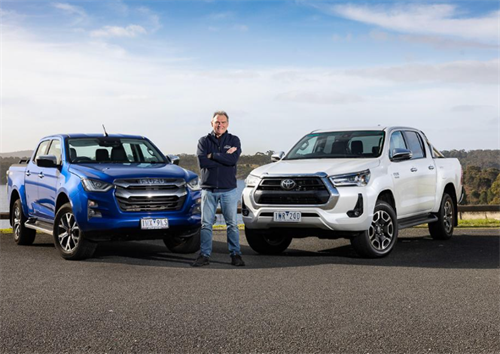
The Hilux cabin is designed for robustness, featuring hard-wearing materials and supportive fabric seats suitable for long drives or off-road use. Its dashboard remains functional, though somewhat dated, with small infotainment screens and analogue controls.
The D-MAX interior is slightly more modern, with quicker infotainment response, better Apple CarPlay and Android Auto integration, individual tire pressure monitoring, and more USB charging options. While the Hilux provides superior build quality and tactile solidity, the D-MAX excels in user-friendly technology, connectivity, and ergonomics. For both tradies and tourers, these differences influence comfort, convenience, and the vehicleâs ability to handle modern mobile and digital requirements on long journeys.
Safety and Warranty:
Both vehicles achieve maximum five-star EuroNCAP ratings, with full active safety suites including autonomous emergency braking, blind spot monitoring, rear cross-traffic alert, and hill assist functions. The Hilux offers Toyota Relax coverage of five years or 100,000 miles in Australia, while the D-MAX provides a six-year warranty capped at 150,000 km in Thailand. Extended warranties, combined with robust safety systems, reinforce long-term reliability and owner confidence, especially for vehicles expected to operate in challenging conditions for extended periods.
Real-World Reliability and Long-Term Ownership
The Hiluxâs reputation is reinforced by its repeated success in extreme motorsport events such as the Dakar Rally, confirming drivetrain resilience and structural integrity. Its suspension components and leaf spring bushings, however, may require attention beyond 200,000 km in extreme outback usage.
The D-MAX, tested extensively in urban stop-start cycles and rural payload-heavy operations, demonstrates exceptional long-term durability. Fleet data shows fewer downtime days, superior payload handling, and reliable traction even in adverse weather. In practical terms, the Hilux offers high engine power and excellent ground clearance, whereas the D-MAX provides operational efficiency, load versatility, and off-road traction optimized for real-world conditions.
Recommended Upgrades for Longevity and Versatility
To maximize long-term reliability and versatility, both models benefit from specific upgrades. Hilux owners are advised to consider taller, aggressive all-terrain tyres, dual-battery setups, enhanced frontal protection, and suspension modifications for heavy towing or off-road touring.
D-MAX users gain from GVM kits to accommodate additional payload, aftermarket upper control arms for improved suspension geometry, and practical accessories such as roof racks, hard lids, and long-range fuel storage. These targeted enhancements preserve mechanical integrity, improve comfort under load, and optimize off-road performance without compromising warranty or reliability.
The choice between the Hilux and D-MAX ultimately depends on the ownerâs operating environment and priorities. For high-mileage touring, off-road adventures, or payload-intensive applications, the D-MAX Blade offers superior traction, factory-fitted off-road tyres, and long-term operational efficiency. For users prioritizing on-road handling, engine responsiveness, towing, and build quality, the Hilux GR Sport excels, particularly in rugged Australian terrain. Both vehicles represent pinnacle examples of Japanese pickup engineering, but the ideal selection is dictated by real-world stressors, environmental conditions, and intended use. Over a ten-year horizon, these factorsânot simply brand reputationâdetermine the most practical, reliable, and cost-effective choice.
References:
[1]Toyota Motor Corporation. (2024). Hilux ten-year reliability and field service data overview. Toyota Technical Journal.
[2]Isuzu Motors Limited. (2025). D-MAX Blade performance and maintenance report. Isuzu Publications.
[3]van Duyl, T. (2025). Isuzu D-MAX Blade vs Toyota HiLux GR Sport: Which flagship ute tows and tours better. CarExpert.
[4]Vansdirect. (2025). Toyota Hilux vs Isuzu D-MAX: Ultimate pick-up comparison.
[5]J.D. Power. (2024). Vehicle Reliability Study â Australia & Thailand.
Recommended for you